





How old is the ‘Wedding Cake’ in Poole’s Cavern?
Wednesday 11th March 2026
Professors Gina Moseley (University of Innsbruck) and John Gunn (University of Birmingham and a BCA Trustee) intend to answer this question – and to find out how old some of the other Poole’s speleothems are.
Which Wedding Cake are they interested in?
One of the speleothems (calcite deposits) that our cave custodians point out to visitors is a very fine stalagmite boss now commonly called “The Wedding Cake” but in the past sometimes referred to as ‘the Font’) which is close to the fence at the start of the Bridge. A question often asked about the Wedding Cake and other speleothems in the cave is “how old is it” and the only accurate answer is “we don’t know for certain”, although lots of guesses have been made! However, this is hopefully soon going to change.
Where to start?
Speleothems are composed almost entirely of calcium carbonate in the form of calcite but they also contain trace elements such as uranium. After deposition, uranium is subject to radioactive decay and one of the daughter products is thorium. By measuring the exact amounts of two isotopes, uranium-234 and thorium-230, in the calcite, and calculating the ratio between them, scientists can determine how long ago the calcite was deposited.
The measurements have to be made in a specialist laboratory using a mass spectrometer and BCA were delighted that after visiting Poole’s with her students in 2024, Professor Gina Moseley agreed to date some of the Poole’s speleothem. As Poole’s Cavern is a Site of Special Scientific Interest, permission to sample the speleothem was needed from Natural England and when this was granted Gina visited Poole’s with Professor John Gunn to collect samples.
How are the samples collected?
This is done by drilling a core through the speleothem in much the same way as cores are obtained from trees to study their age. Three sites were sampled, including the Wedding Cake, and we hope to have results of the dating exercise in the next few months.
Normal practice is to carefully seal the hole left behind when the core is extracted to maintain the visual integrity. However, the hole near path level in the Wedding Cake has deliberately been left open. This was because the drill was not long enough to reach the centre of the stalagmite which is where the earliest calcite was deposited and it is hoped that Gina may be able to return with a longer drill bit.
What happens next?
The cores are now on their way to the University of Innsbruck where they will be carefully cut in half along the centre line. This is so that for each core one half can be dissolved as part of the analytical process whilst the other half will eventually be returned to Buxton and displayed in the Poole’s Cavern Museum. Once dissolved, the liquid will go through a series of complicated chemical processes before it is placed in a mass spectrometer and the amounts of uranium-234 and thorium-230 will be measured. Finally, the ages will be calculated to tell us when the calcite was deposited and then we can tell you just how old the Wedding Cake, and other Poole’s speleothems really are!
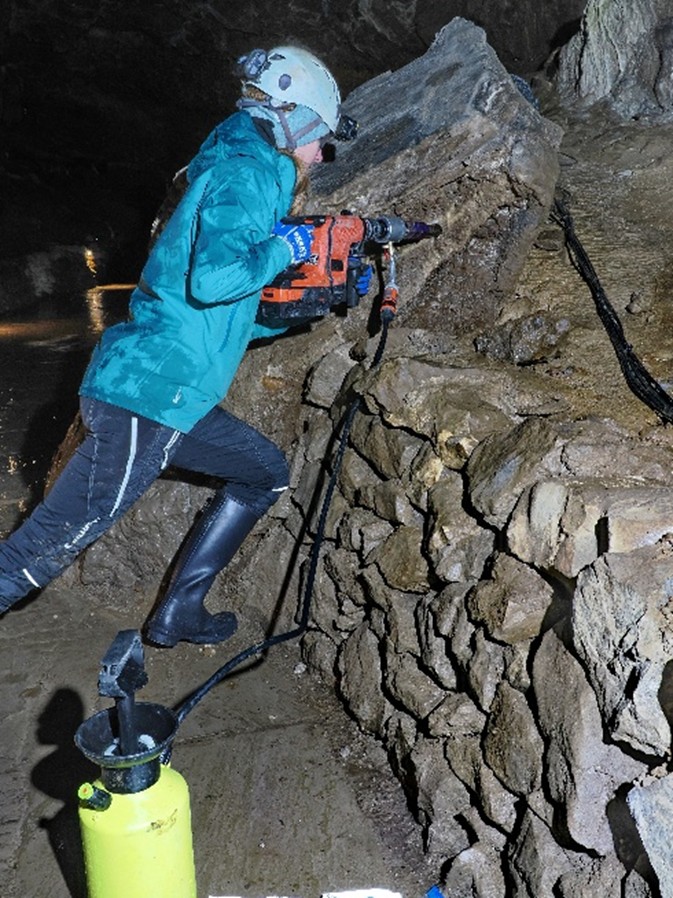
Professor Moseley coring a speleothem beneath ‘The Dome’.
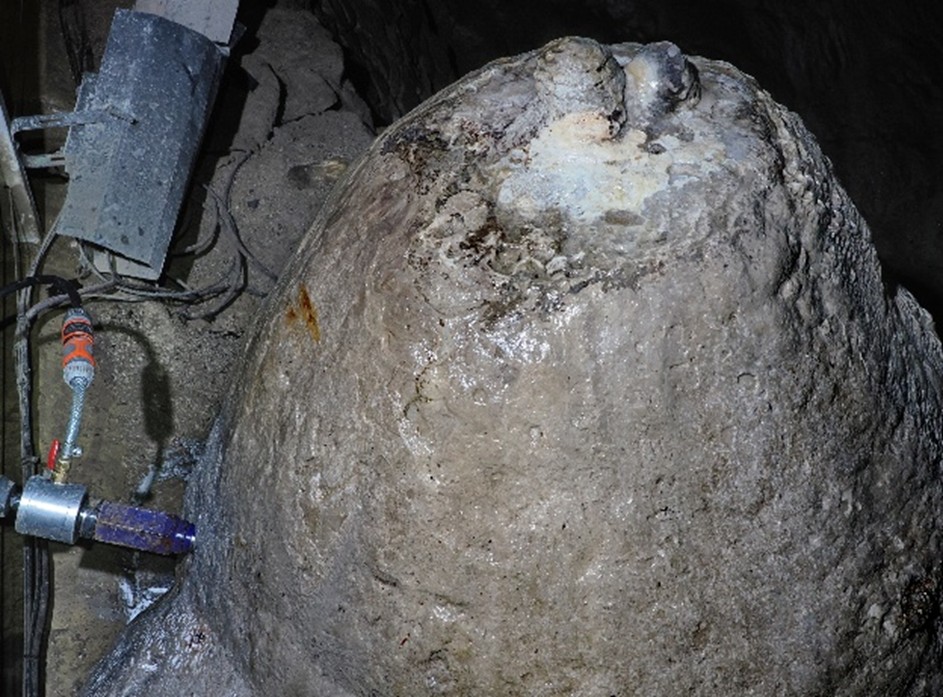
The Wedding Cake stalagmite with the drill.
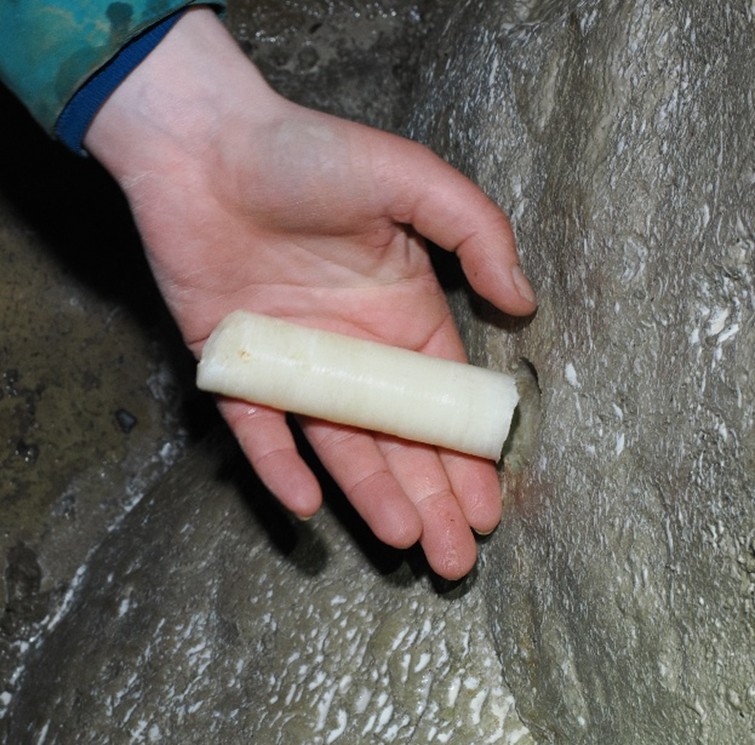
Core extracted from the Wedding Cake