




Poole’s Cavern – the British Cave Science Centre
Thursday 20th November 2025
Forword by Prof. John Gunn
The British Cave Science Centre (BCSC) is a joint project between Buxton Civic Association (BCA) and the British Cave Research Association (BCRA) that began in 2018. The primary objective is to record a high resolution (10 minute) long-term (30 years plus) record of the baseline climate in the cave and outside, making the data available to the global scientific community free of charge.
Outside the cave, in 10-minute intervals, we record the air temperature, barometric pressure, relative humidity and rainfall.
Inside the cave, we record the air temperature, barometric pressure, the direction and velocity of airflow, and the drip rate carbon dioxide concentration. These data are uploaded to a central repository from where they can be downloaded.
The BCSC also provides a cave research facility for the scientific community with a safe working environment for students to undertake projects. Higher level scientific projects are also undertaken, such as work by Professor Mike Rogerson of Northumbria University on alkaline leachates.
Update by Prof. Mike Rogerson on his ongoing experiment in Poole’s Cavern 18/10/2025
Keep an eye on the ground when you are walking through the cave. Rocks are growing down there. Stalagmites grow when a drip from the roof hits the floor and deposits a little bit of the mineral calcite, and they quite happily grow on paths and even on railings inside Poole’s Cavern. They grow especially fast in the part of the cave we call “The Poached Egg Chamber”. So fast, in fact, the staff recently had to remove some two of them.
This isn’t a simple operation – the cave is a protected Site of Special Scientific Interest (SSSI), which means a report has to be submitted to Natural England whenever changes like this are made. But these two were beginning to become a trip hazard, they really did have to go.
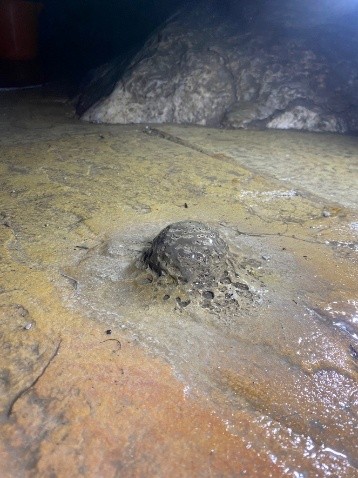
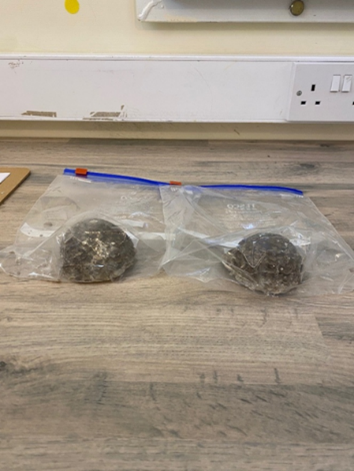
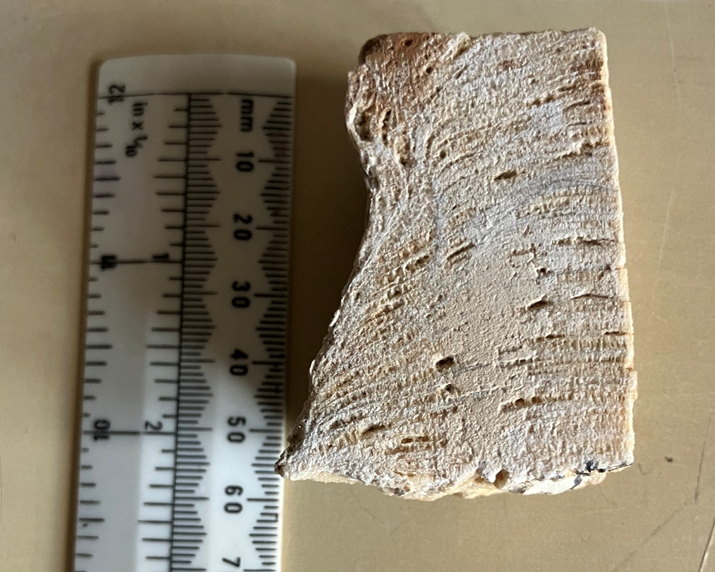
The fast-growing stalagmites are curious things when you cut into them. They have a really layered structure, with a hard glassy layer, always paired with a powdery white layer which often has holes in it. We know from previous research efforts that each pair of layers formed in just one year. You can read the previous research here.
You can see in the picture below, the powdery layers are always thicker, and the pairs are 1-3mm thick. At that rate, the piece in that photograph grew in 20 or 30 years. But wait a moment – didn’t the Poole’s Cavern custodians tell you it took thousands of years to grow a stalagmite? That’s absolutely true, normally. These ones in the Poached Egg Chamber are a bit special.
The stalagmites grow exceptionally fast because as well as the normal process of rocks dissolving and redepositing below the drip, the waters there are affected by lime residue from the long history of quarrying limestone for building and agricultural products, which is still an important industry in Buxton. This residue dissolves into the water raising the amount of calcium in it, also pushing up the pH to make it unusually alkaline.
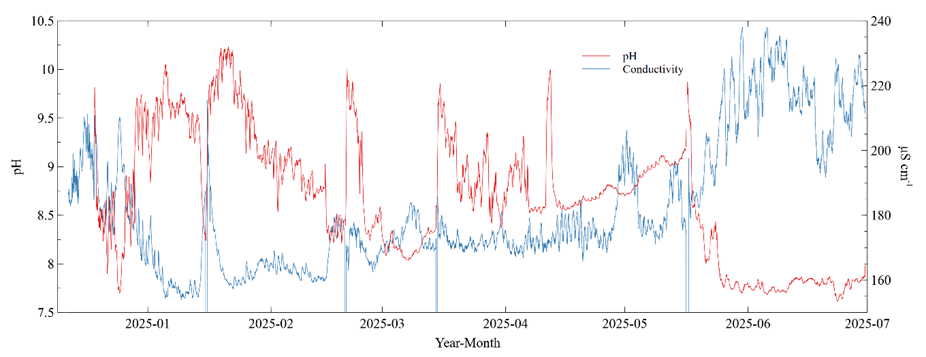
That has been known for ever, but in the last year Northumbria University’s research project has shown that the residue doesn’t affect the water in the summer, but it does in the winter.
In the graph below you can see a red line for pH, and when this goes up above a value of 8.5 that is when the water is being affected by the residue. High pH leads to fast growth of stalagmites, makes powdery layers with holes in them and makes trip hazards grow on the paths.
Those trip hazards help us to understand the whole story, because the two little stalagmites that were removed will have a record of the way the industrial residue is locked in them – as will the longer stalagmite that was removed in 1997 for the original study that showed the layers were each one year long. And together, those stalagmites hold a memory of how the residue has affected the water since the 1920’s.
We now have them in the labs at the University of Hull, where we will extract the long story of how the lime waste above the cave in Grin Low Plantation has been slowly, slowly washing away, feeding the Poached Egg Chamber in Poole’s Cavern.
A final note from BCA Assistant Managers, Sam Wilks and Alison Ewart, who together oversee the British Cave Science Centre at Poole’s Cavern, working with scientists from around the country.
It will be exciting to see the results gathered from testing our recent stalagmite samples and it is always a great outcome when a negative (trip hazard in this case), can be turned into a positive, with the opportunity to conduct further experiments on these unique stalagmites.
We are both excited for the future of the British Cave Science Centre and hope we can share more of this story on our tours of the cavern, as we discover more about this fascinating subterranean world.

Edited by Leah Mycock