





Eagle Parade Conduit
A Landmark of Victorian Engineering and Civic Pride
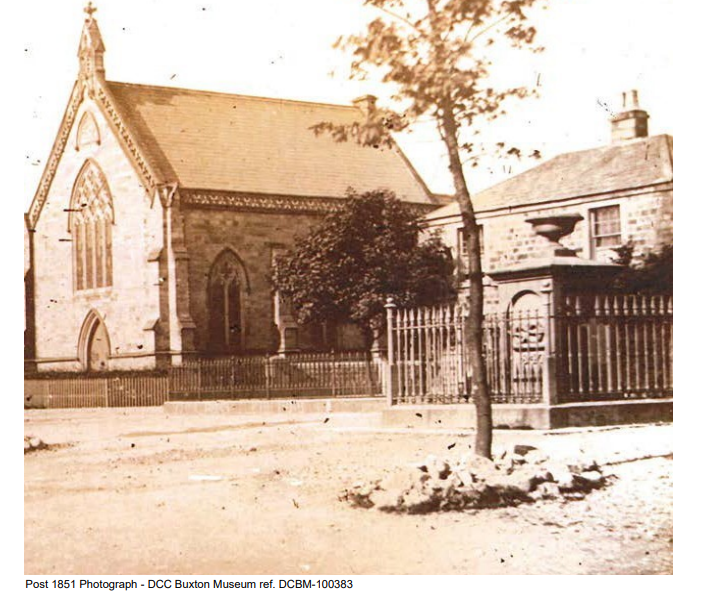
The Eagle Parade Conduit is an important reminder of the town’s Victorian commitment to public health and civic improvement. Built in 1840, the conduit provided clean drinking water to residents and became one of the defining features of the Market Place.
Its planned restoration celebrates not only its architectural significance, but also its place in Buxton’s social and cultural history.
The Need for Clean Water
During the early nineteenth century, access to safe drinking water was a matter of life and death. In 1831, typhoid spread through the Derbyshire villages of Beeley and Pilsley from contaminated ponds used by both people and livestock.
At the same time, Britain was experiencing its first cholera epidemic, which claimed more than 52,000 lives by the end of 1832. Against this backdrop, improving public water supplies became an urgent priority.
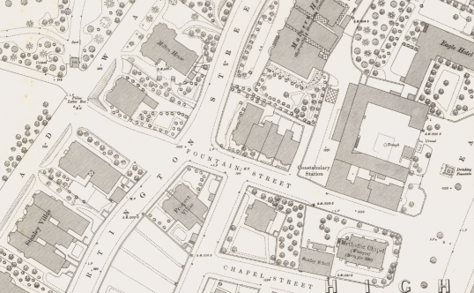
1878 Ordinance Survey Map (Reproduced with the permission of the National Library of Scotland)
A Gift to the Town
The Eagle Parade Conduit was commissioned under the patronage of William Cavendish, 6th Duke of Devonshire, and completed in June 1840 on land acquired by the Chatsworth Estate beside the Eagle and Child Hotel.
Joseph Paxton, the Duke’s principal designer in Buxton, was overseeing improvements to the Crescent Slopes during this period and is thought to have designed the conduit. Its construction represented both Victorian engineering ambition and the Duke’s commitment to the welfare of the town.
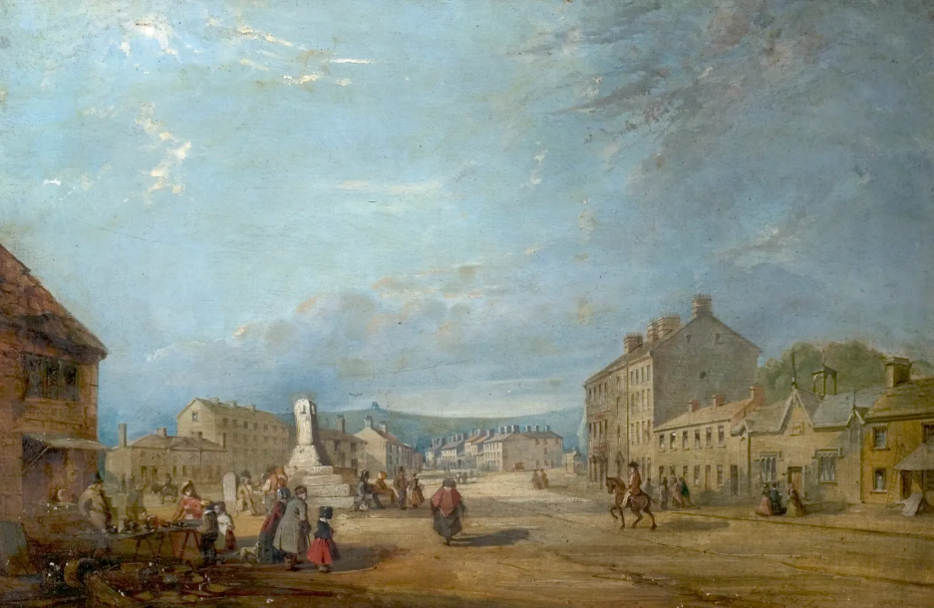
Buxton Market Place. Godfrey Sykes, 1849 (Derbyshire County Council: Buxton Museum and Art Gallery)
Changing Needs
The conduit became largely redundant within twenty years following the construction of Watford Reservoir in 1853 and the installation of piped water supplies to homes in the surrounding area. The original cast-iron supply pipes from Cold Springs had also become badly corroded and were prone to freezing.
Between 1864 and 1868, Robert Rippon Duke directed major improvements to Buxton’s water infrastructure, including new reservoirs, domestic pipework, baths and drinking fountains. During this period, two cast-iron drinking fountains and catchment bowls were added to the Eagle Parade Conduit.
When the Buxton Local Board purchased the waterworks from the Chatsworth Estate in 1872, the disused conduit was excluded from the transfer.
The Birth of Buxton Well Dressing
The opening of the Eagle Parade Conduit on 24 June 1840 marked the beginning of what became one of Buxton’s best-loved traditions.
Writing in 1847, the Manchester Times observed that well dressing “took its rise in the gratitude of the people to the Duke of Devonshire, for a public fountain.”
Photographs from the 1920s and 1930s show the original cast-iron railings and reveal details of the conduit’s internal workings. The railings were removed during the Second World War for scrap metal, but the annual well dressing of the conduit remains a highlight of the Buxton Well Dressing Festival.
Restoring a Lost Landmark
In 2025 and 2026, Buxton Civic Association began a major programme to conserve and restore the Grade II-listed Eagle Parade Conduit. Planning permission and listed building consent is currently being sought to ensure that the work follows best conservation practice and safeguards the structure for future generations. The project includes repairs to the stonework, reinstatement of missing architectural features and the careful conservation of surviving historic fabric.
Working with Bench Architects, specialist contractor R M Eaton Stonemasonry and Calibre Metalwork, Buxton Civic Association aims to return the conduit to something much closer to its nineteenth-century appearance. The project will help preserve one of Buxton’s earliest public water monuments and strengthen its role in the town’s heritage and well dressing traditions.
Project Team
Patron: Richard Vessey
Architect: Bench Architects
Project Archaeologist: Dr. Ian Parker Heath/Enrichment Through Archaeology
Main Contractor: R M Eaton Stonemasonry
Ironwork: Calibre Metalwork
Client: Buxton Civic Association