


Explore the Wonderful World of Cave Science!
Poole’s Cavern is not just a fascinating place to explore; it is also a special site where scientists study caves and the world beneath our feet.
In 2018, BCA and the British Cave Research Association agreed to develop the cavern as the British Cave Science Centre. Since then, researchers have been studying a range of topics from the air in the caves to bacteria on the rocks.
This research supports BCA in protecting the site for the future. It also helps guides educate visitors about climate change and human impacts.
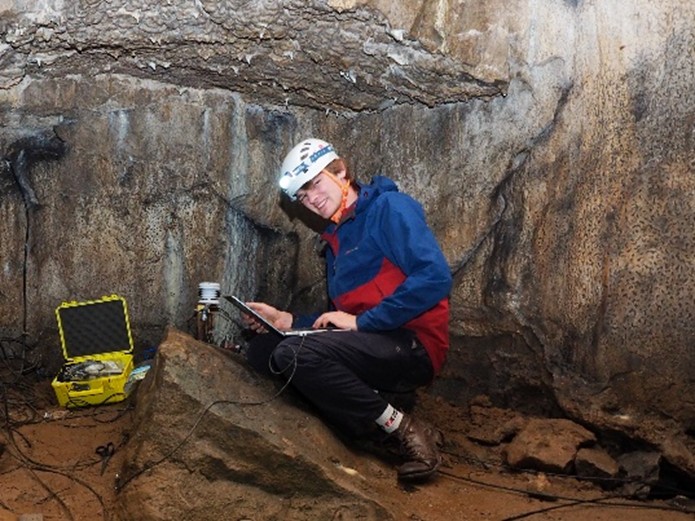
Ben Wynn, an undergraduate student at Durham University, undertook his honours dissertation in the cave: "A comparison of different carbon dioxide meters to assess their suitability for long-term, high-resolution monitoring in caves". Here, Ben is downloading one of his data loggers. © British Cave Science Centre
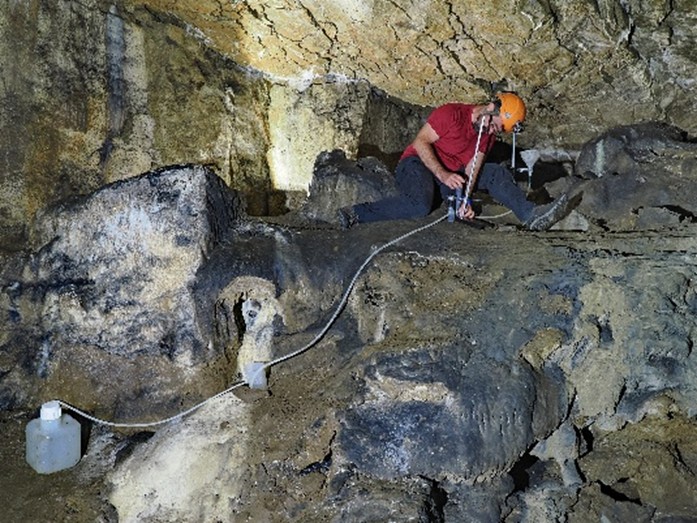
This experiment, being undertaken by Professor Mike Rogerson (Northumbria University), examines how the chemistry of water entering the cave changes over time. The instrument measures water flow, pH, electrical conductance and temperature every 20 minutes. The pH tells us how much the lime tips on Grin Low are affecting the water, and the conductance tell us how much lime and how much rock is dissolved in the water. Having data collected several times an hour means we can work out how the impact of the lime tips changes with the seasons and even following individual rainstorms. © British Cave Science Centre
What is Speleology?
Speleology is the scientific study and exploration of caves. It examines how caves form, what lives within them, and how their environments change over time.
At Poole’s Cavern, scientists have monitored the cave’s climate every 10 minutes since 2018. As you explore, you will see sensors measuring airflow, drip rate, pressure, carbon dioxide levels and the depth, temperature and chemistry of the cave stream.
Radon gas concentrations are commonly higher inside caves than in the outside atmosphere, so scientists also monitor radon at Poole’s Cavern to ensure the safety of visitors and staff.
Outside the cave, scientists track atmospheric pressure, rainfall, and temperature. Changes in rainfall affect drip rates in the cave and river depth. Even small shifts in temperature or wind direction can significantly alter airflow inside the cave.
With millions of observations collected so far, these data help us understand how caves function. It’s like being a detective – piecing together clues hidden in the rocks, water, and air!
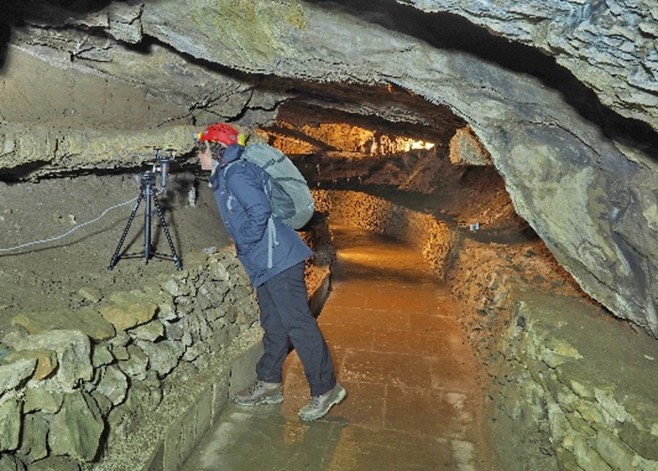
The concentrations of carbon dioxide and radon in the cave atmosphere are related to the ventilation - whether air is moving in or out of the cave and the velocity of movement. This instrument, located close to the entrance, is an ultrasonic anemometer which measures the direction and velocity or air movement. © British Cave Science Centre
Continue Your Discovery
Poole’s Cavern is a treasure trove of science, adventure, and discovery. With the help of cave science, we can understand more about the hidden world beneath our feet – and keep it safe for future generations to explore!
Want to learn more about the wonderful world of cave science? Visit the British Cave Science Centre website to continue your discovery.
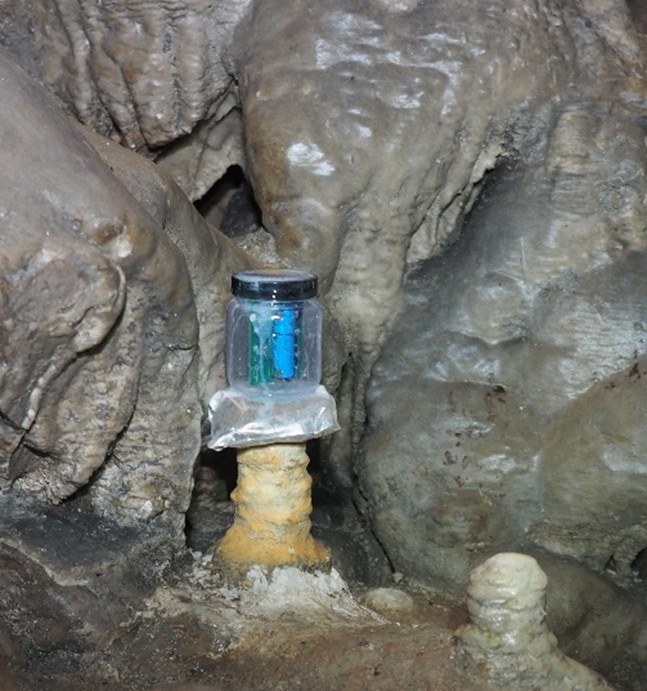
In addition to instruments that record data and send it out of the cave scientists also deploy 'stand-alone' instruments such as this Goodsell drip-logger. The logger records and stores data which is downloaded in the cave by researchers. © British Cave Science Centre
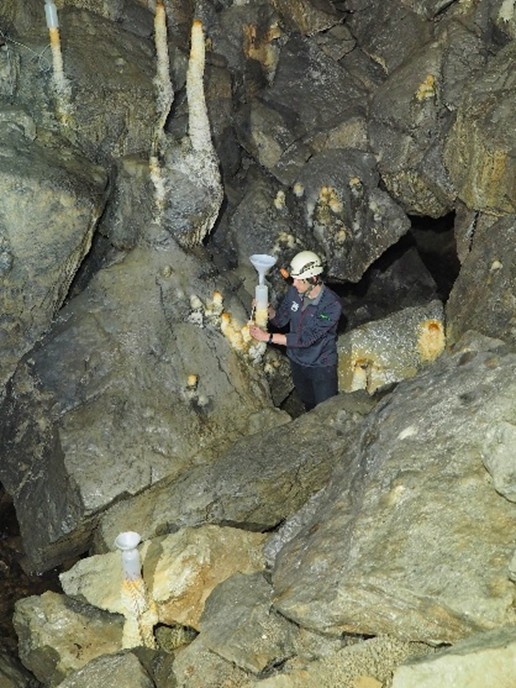
Alistair Morgan collecting water samples in the Poached Egg Chamber as part of research for his MSc at Lancaster University. His research focussed on understanding how phosphorous enters cave systems and if, when it is incorporated into stalagmites, it can be used to unravel past temperatures. © British Cave Science Centre
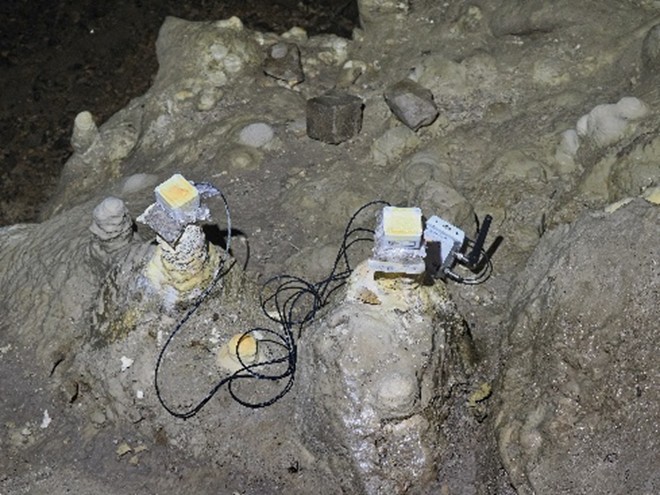
Rain falling on the surface above the cave follows complex routes through the soil and rock before it emerges through the cave roof and drips to the floor. These two instruments record each drop of water falling on them. The total number of drips in each 10-minute period are recorded by the logger. Scientists can then compare drip rates with rainfall recorded by the gauge outside the cave. The loggers are linked to radio-transmitters that send data out of the cave to a computer linked to the internet so that researchers can view the data in close to 'real-time'. © British Cave Science Centre